Saturday, May 14, 2011

HTC Incredible internal memory

My phone, an HTC Droid Incredible, may be hopelessly antiquated by the standards of true mobile hipsters. Still, it came with a generous 8GB internal storage. Too bad the SD card is a chintzy 2GB. These days, you get more than 2 gigs on an abacus. It seems like Android wants to use internal storage for the OS and apps, reserving the SD card for media, which makes that 8GB/2GB split a little awkward. I filled that 2GB right up with choice sides of Miles and 'Trane in no time. And, what do I need with 8 gigs worth of apps? What am I running, Bloatpad 2.0? So, anyway, I decided I wanted to use the empty 6 plus gigs on the internal storage for some Thelonious. So, can I do that?

Well, the Help/How to thing at HTC says, "...Music only plays audio files saved on the storage card...". Well, I use another media player anyway - Meridian. Then there's an article called Programmitically accessing internal storage (not SD card) on Verizon HTC Droid Incredible (Android), which says, "To be quite honest, the internal storage is a joke. Just think of it as a flash drive..."

But, it turns out, you can access music and other media on the internal storage. You just have to know that the internal storage is mounted as /emmc. Maybe they shoulda called it /WTF.

Saturday, May 07, 2011

Rails 3 MongoDB recipe

Here's a quick and dirty recipe for getting started with MongoDB and Rails 3 using mongo_mapper. We'll get set up and test out a Restful web service.

I installed MongoDB with MacPorts.

sudo port selfupdate
sudo port install mongodb

Start a rails project. You may want to leave out ActiveRecord using the switch --skip-active-record as suggested by the Getting Started guide. That's optional. You might want to leave it in, if you intend to use a relational DB alongside Mongo.

  rails new <myproject>

Add to Gemfile

source 'http://gemcutter.org'
gem 'mongrel'
gem 'mongo_mapper'
gem 'bson'
gem 'bson_ext'
gem 'SystemTimer'
gem 'rails3-generators'
gem 'json'

Bundler happily installs all this stuff.

bundle install

Create config/initializers/mongodb.rb

MongoMapper.connection = Mongo::Connection.new('localhost', 27017)
MongoMapper.database = "#myapp-#{Rails.env}"

if defined?(PhusionPassenger)
   PhusionPassenger.on_event(:starting_worker_process) do |forked|
     MongoMapper.connection.connect if forked
   end
end

Start the MongoDB server, giving it a place to put data files:

mkdir <path>/data
mongod --dbpath <path>/data

Create an entity to be stored in MongoDB. I like to use a database of Nerds as my test application.

rails generate scaffold Nerd name:string description:string iq:integer --orm=mongo_mapper 

I originally gave description type "text", but that didn't work for me, producing, "NameError in NerdsController#show, uninitialized constant Nerd::Text". So, I edited the model file to look like this:

class Nerd
  include MongoMapper::Document         
  key :name, String
  key :description, String
  key :iq, Integer
end

Getting mongodb objects as XML doesn't work?

I saw an error: undefined method `each' with mongo_mapper (0.8.6), which was fixed by upgrading to (0.9.0)

Started GET "/nerds/4dc5c41a1ff2367744000004.xml" for 127.0.0.1 at Sat May 07 15:41:54 -0700 2011
  Processing by NerdsController#show as XML
  Parameters: {"id"=>"4dc5c41a1ff2367744000004"}
Completed 200 OK in 9ms (Views: 2.6ms | ActiveRecord: 0.0ms)
Sat May 07 15:41:54 -0700 2011: Read error: #<NoMethodError: undefined method `each' for #<Nerd:0x1040bfb80>>

JSON web services in Rails

You'll likely want to serve up and accept JSON in HTTP requests. For some crazy reason, Rails doesn't generate code for JSON in the controller, only HTML and XML. You have to add a line to the respond_to code block, like this:

class NerdsController < ApplicationController
  # GET /nerds
  # GET /nerds.xml
  def index
    @nerds = Nerd.all

    respond_to do |format|
      format.html # index.html.erb
      format.xml  { render :xml => @nerds }
      format.json { render :json => @nerds }
    end
  end

  # GET /nerds/1
  # GET /nerds/1.xml
  def show
    @nerd = Nerd.find(params[:id])

    respond_to do |format|
      format.html # show.html.erb
      format.xml  { render :xml => @nerd }
      format.json { render :json => @nerds }
    end
  end
  ...
end

Use curl to test that this works. First, get HTML, then ask for JSON using the accept header.

curl --request GET -H "accept: application/json" http://localhost:3000/nerds/4dc5c41a1ff2367744000004

OK, now we can serve JSON, how about receiving it in POST requests? Another couple quick additions and we're in business.

# POST /nerds
# POST /nerds.xml
def create
  @nerd = Nerd.new(params[:nerd])

  respond_to do |format|
    if @nerd.save
      format.html { redirect_to(@nerd, :notice => 'Nerd was successfully created.') }
      format.xml  { render :xml => @nerd, :status => :created, :location => @nerd }
      format.json  { render :json => @nerd, :status => :created, :location => @nerd }
    else
      format.html { render :action => "new" }
      format.xml  { render :xml => @nerd.errors, :status => :unprocessable_entity }
      format.json  { render :json => @nerd.errors, :status => :unprocessable_entity }
    end
  end
end
curl --request POST -H "Content-Type: application/json" -H "Accept: application/json" --data '{"nerd":{"name":"Donald Knuth", "iq":199, "description":"Writes hard books."}}' http://localhost:3000/nerds

If you have an entity named "nerd" it's pretty reasonable to expect the XML representation to look something like <nerd>...</nerd>. By analogy to that, they expect your JSON to look like this {"nerd":{...}}, which I'm not sure I like. I coded around the issue, which is might be unwise, by making the controller's create method look like this:

# POST /nerds
# POST /nerds.xml
def create

  input = params[:nerd] || request.body.read
  if request.content_type == 'application/json'
    @nerd = Nerd.new(JSON.parse(input))
  else
    @nerd = Nerd.new(input)
  end

  respond_to do |format|
    if @nerd.save
      format.html { redirect_to(@nerd, :notice => 'Nerd was successfully created.') }
      format.xml  { render :xml => @nerd, :status => :created, :location => @nerd }
      format.json  { render :json => @nerd, :status => :created, :location => @nerd }
    else
      format.html { render :action => "new" }
      format.xml  { render :xml => @nerd.errors, :status => :unprocessable_entity }
      format.json  { render :json => @nerd.errors, :status => :unprocessable_entity }
    end
  end
end

...which you can test with curl like so:

curl --request POST -H "content-type: application/json" --data '{"name":"Bozo", "iq":178, "description":"A very smart clown."}' http://localhost:3000/nerds

So, there you have it - Rails 3 and MongoDB playing ReSTfully together.

Warning: Current release versions of MongoDB have a 4MB maximum document size. This makes some sense as documents are often serialized and deserialized in memory. Apparently, this is being raised in later versions. Fully streaming APIs would certainly help, but that brings up the question of how much of the XML dog-pile of technologies will (or should) be replicated in JSON. Guess we'll see.

Thursday, April 21, 2011

Genome Browser's Anonymous

As you may know, I'm starting a support group for those afflicted with the tragedy of having written a genome browser. Mine is called the Gaggle Genome Browser. About the time I was writing it, everyone and their uncle's dog decided to write a genome browser. New instruments with new data types were coming into the lab. Computers had more memory and CPU cores than ever. It seemed like a good idea at the time.

The Broad Institute's Integrative genomics viewer (shown below) got a write-up in the January Nature Biotechnology. IGV seems particularly well developed for next-gen sequencing data, nicely displaying coverage plots and alignments of short reads, with attention to the nuances of paired-ends.

IGV is a Java desktop app that pulls data down from a server component, the IGV Data Server. In my case, I cooked up a two level hierarchy for caching chunks of data in memory backed by SQLite. It's probably smart to add a server as a third level. IGV's multi-resolution data mode precomputes aggregations for zoomed-out views in which data is denser than the pixels in which to display it. IGV splits data into "tiles" stored in a custom indexed binary file format. "Hence a single tile at the lowest resolution, which spans the entire genome, has the same memory footprint as a tile at the very high zoom levels, which might span only a few kilobases." My GGB aggregates on the fly, which hurts performance in zoomed out views.

The IGV Data Server seems to derive a lot of it's data from the UCSC Genome Browser, which maintains nicely curated data mapped to genomic coordinates for a bunch of eukaryotes and also microbes. One thing I enjoyed hacking with on GGB was integration with R. I wonder if that would be worthwhile for IGV.

Which functionality to put on the client vs. which in the server is debatable. We considered building a browser based implementation, experimenting a bit with the super-cool protovis visualization library. We went with desktop. X:map is a nice counter-point, an interactive web-based genome browser. In their approach, the Google Maps API serves up pre-rendered image tiles, keeping the big data and heavy-weight computing tasks on the server. They also have an R and Java program that lets you plot custom data. JBrowse, from CSHL, does the rendering in the browser. Putting a data intensive and graphically interactive app in the browser is still somewhere near the edge of the envelope, but browsers are improving like crazy, as are programming models for this type of development.

For what it's worth, I like the format of the IGV paper. It concisely covers motivation, what the software does, a few unique features and a couple figures showing example applications, all at a high level overview in just two pages. A supplement contains the technical detail of interest to software developers along with more example applications. I like that better than trying to awkwardly shoehorn biology and software engineering together.

Anyway... Nice work, IGV team! Let me know if you'd like to join the support group. We're here to help.

Sunday, April 17, 2011

You can't optimize what you can't predict

In a post about the relationship between predictive analytics and operations research, Harlan Harris says, "You can't optimize what you can't predict." Predictive analytics is using statistical and machine-learning tools on large data sets to find complex relationships in the data and predict future trends. Operations research is the process of optimizing supply chains and industrial systems.

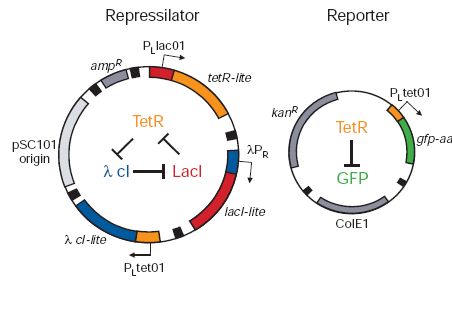
A synthetic oscillatory network of transcriptional regulators, Elowitz and Leibler, Nature, 1999

It's interesting because the same relationship exists between systems biology and synthetic biology. (At least we hope it does.) That is, understanding, modeling and predicting a system will eventually let you bend it towards your own ends. Same techniques, different domains. Systems biology is essentially predictive analytics on biological data. It hopes to build models and discover principles that will guide synthetic biology, which re-engineers biological systems toward novel and useful functions - everything from cleaning up toxic waste to producing energy. And the process of building entirely new biological processes inevitably feeds back into better understanding of natural biological systems.

It would be a great validation of systems biology methods to do a blind analysis of a synthetic biological circuit. Even better would be to predict the behavior of a synthetic system, then build it and see how well we did. If we do that enough times, we can't help but improve our ability to predict and optimize biological systems.

Sunday, April 10, 2011

Thinking about CRUD has damaged your karma

I'm spending some time trying out MongoDB. Mongo is a NoSQL database that stores documents in a binary variant of JSON called BSON.

Mongo is often compared to CouchDB. But, aside from the fact that they both store JSON documents, their approaches are quite different.

Mongo stores documents in collections, which are vaguely like tables in a SQL database. Mongo queries are partial JSON documents matched against existing documents in the database. Couch builds views with map-reduce and is, in general, a little more conceptually heavy while Mongo is more straight forward with direct analogs to most SQL features.

One feature I like is the mongo console. It's a full javascript interpreter, which means you can easily script bulk updates and maintenance tasks.

The MongoDB site has a quickstart guide for popular OS's and a tutorial that will get you started using the console, as well as specific guides for loads of client languages.

You have not yet reached enlightenment...

From within Ruby, we can communicate with MongoDB with the mongo, bson and bson_ext gems. One fun way to learn about using MongoDB from Ruby is through the nicely kooky MongoDB_Koans, a series of unit tests with small omissions or bugs. You fix the bugs and make the tests pass, while the test harness gently urges "Please meditate on the following code...".

Thursday, April 07, 2011

Installing the Ruby mysql gem

I've had issues installing the ruby mysql gem a couple of times, so I thought I'd document what finally worked here. I had Rails 2.3.8 running on the pre-installed Ruby 1.8.7 that comes with OS X 10.6. I needed to install Rails 3.x for another project. Having multiple versions of Rails is supposed to work OK, so I just did:

sudo gem install rails

Problems began here, but I flailed rather than keeping careful notes. At some point, I ended up thinking an fresh install of MySQL might help, so I installed version 5.5.9 from the DMG on dev.mysql.com. Maybe, I shoulda used MacPorts, cause that made things worse. After that, neither version of rails could connect to MySQL and my cubical-neighbors had new respect for my colorful vocabulary. Rails would fail, croaking up this cryptic message:

uninitialized constant MysqlCompat::MysqlRes

This thread helped. You need to be careful that MySQL, Ruby and MySQL/Ruby are compiled to a common architecture. You can do this by specifying ARCHFLAGS in the environment.

sudo env ARCHFLAGS="-arch x86_64" gem install --no-rdoc --no-ri mysql -- --with-mysql-config=/usr/local/mysql/bin/mysql_config

Compiling the gem properly is one step. The gem depends at run time on the mysql client library, which it needs to be able to find. Specify that, like so:

export DYLD_LIBRARY_PATH="/usr/local/mysql/lib:$DYLD_LIBRARY_PATH"

With the combination of these two clues, both versions of Rails seem to work happily.

Diagnosing problems with Ruby and Gems

A couple key commands for debugging RubyGems are gem list and gem env. Also, gem uninstall for removing the wreckage of failed attempts. Some recommend RVM, which I may try out some time. Also, I use the deprecated practice of installing gems with sudo. I guess I should learn to install them in my user directory.

The Ruby that comes with OS X 10.6, at least on my machine, looks like this:

$ /usr/bin/ruby --version
ruby 1.8.7 (2009-06-12 patchlevel 174) [universal-darwin10.0]

$ file /usr/bin/ruby
/usr/bin/ruby: Mach-O universal binary with 3 architectures
/usr/bin/ruby (for architecture x86_64): Mach-O 64-bit executable x86_64
/usr/bin/ruby (for architecture i386): Mach-O executable i386
/usr/bin/ruby (for architecture ppc7400): Mach-O executable ppc

Installing a fresh Ruby from MacPorts probably wasn't necessary, but that didn't stop me:

$ which ruby
/opt/local/bin/ruby

$ /opt/local/bin/ruby --version
ruby 1.8.7 (2011-02-18 patchlevel 334) [i686-darwin10]

$ file /opt/local/bin/ruby 
/opt/local/bin/ruby: Mach-O 64-bit executable x86_64

I hope this helps someone. This is a pain, but the same thing in Python is worse.

Monday, April 04, 2011

Art house video games

Where are the art house video games? I remember reading that the novel was once considered a time waster for idlers well beneath the level of serious art. What is art, anyway? TV spent decades in the shallows before growing artistic pretensions. These days, you can take a university class about The Wire. Maybe soon we'll be able to take a class in Halo studies, or the semiotics of Grand Theft Auto?

Silly, maybe, but games show a lot more potential than, say, Twitter. Unless someone starts tweeting profound insights in haiku. Have you ever seen a Facebook page you'd describe as raw, edgy, or deep?

Games are, at least, amenable to a Lord of the Rings style quest where the main point is to explore a rich fantasy world. What games are lacking, so far as I know, is the ability to be transformative. How does the writer develop characters when the protagonist, or protagonists, are real people with a will of their own? To induce a change - growth, learning - in a character outside of the writer's control... that would be the real trick.

But the potential of games is there as well. The visuals and audio are already well developed. Interactivity with the game world and the shared experience of multiplayer games is where the untapped potential lies. The medium may be the message, but to succeed on an artistic level games need a message. They need more to say than, "Let's blow shit up!"

Know any games that rise to the level of real art? Put your nominations in comments...